
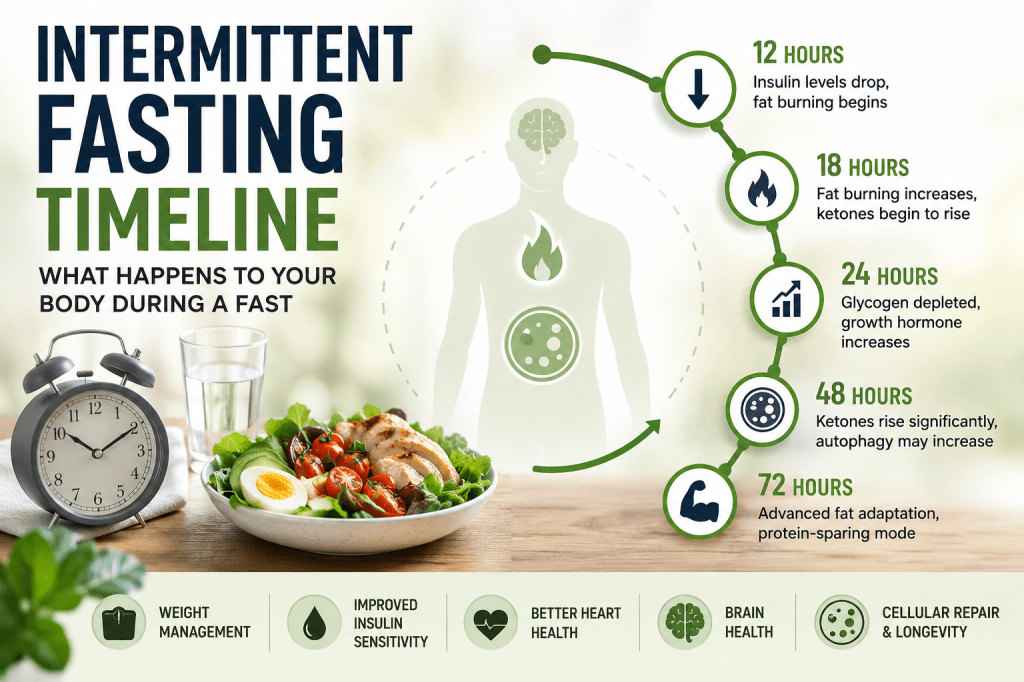
Discover what really happens inside your body during intermittent fasting. Learn how fasting affects insulin, fat burning, ketosis, autophagy, and overall health from 12 to 72 hours.
Intermittent fasting has become one of the most popular health strategies in recent years. Millions of people practice it to lose weight, improve metabolic health, and simplify their eating habits. But while most people know when to eat during intermittent fasting, far fewer understand what actually happens inside the body during a fast.
Your body doesn’t suddenly switch into “fat-burning mode” the moment you stop eating. Instead, it goes through a series of carefully coordinated metabolic changes. Hormones shift, energy sources change, and different repair processes become more active over time.
In this article, we’ll walk through the science-backed timeline of fasting—from your last meal to 72 hours later—and explain how your body adapts every step of the way.
What Is Intermittent Fasting?
Intermittent fasting is an eating pattern that alternates between periods of eating and fasting. Unlike traditional diets that focus on what you eat, intermittent fasting focuses primarily on when you eat.
Some of the most common fasting schedules include:
- 12:12 – Fast for 12 hours and eat during a 12-hour window.
- 14:10 – Fast for 14 hours and eat during a 10-hour window.
- 16:8 – Fast for 16 hours and eat during an 8-hour window.
- 18:6 – Fast for 18 hours and eat during a 6-hour window.
- OMAD (One Meal a Day) – Consume your daily calories in one meal.
- Extended fasting – Fasting for 24 hours or longer, usually under medical guidance.
Regardless of the method, the goal is to give your body periods without food so it can shift from constantly processing incoming calories to using stored energy.
Understanding Your Body’s Energy Sources
Before exploring the fasting timeline, it’s helpful to understand where your body gets its energy.
When you eat, carbohydrates are broken down into glucose, your body’s preferred fuel source. Any extra glucose is stored in the liver and muscles as glycogen, which acts like a short-term energy reserve.
Once glycogen stores begin to decline, your body gradually increases its use of stored fat for energy. As fat is broken down, the liver produces ketones, an alternative fuel that can be used by the brain and many other tissues.
This gradual shift from glucose to fat and ketones is often called the metabolic switch.
What Happens During the First 12 Hours?
Immediately after eating, your body is in the fed state.
Your digestive system breaks down food, blood glucose rises, and insulin helps move glucose into cells where it is used or stored.
Over the next several hours:
- Digestion continues.
- Blood sugar gradually returns toward normal.
- Insulin levels begin to decline.
- The liver starts releasing stored glycogen to maintain stable blood glucose.
By about 12 hours, many people are entering the post-absorptive state, where the body increasingly relies on stored glycogen instead of recently consumed food.
Although fat burning has already begun, glycogen remains the primary source of energy.
What Happens After 18 Hours?
As fasting continues, insulin levels remain relatively low.
This encourages the body to release stored fat from fat cells so it can be used as fuel.
At this stage:
- Fat oxidation increases.
- Glycogen stores continue to decline.
- Ketone production begins to rise in many healthy individuals.
- The body becomes more metabolically flexible.
Many people report feeling:
- Reduced hunger after the initial cravings pass
- Improved focus
- Stable energy levels
However, individual experiences vary considerably depending on diet, activity level, and overall health.
What Happens After 24 Hours?
Around the 24-hour mark, liver glycogen stores are substantially depleted in many people.
To maintain blood glucose for tissues that require it, the body increases gluconeogenesis, a process that produces glucose from non-carbohydrate sources such as lactate, glycerol, and certain amino acids.
At the same time:
- Fat becomes an increasingly important fuel source.
- Ketone production continues to increase.
- Growth hormone secretion rises during fasting, helping support normal metabolism and reducing the breakdown of lean tissue.
This does not mean fasting automatically builds muscle. Rather, increased growth hormone is one of several physiological adaptations that help the body respond to a temporary lack of food.
What Happens After 48 Hours?
By 48 hours, your metabolism has adapted further to fasting.
The liver produces larger amounts of ketones, which provide an efficient source of energy for the brain and other organs.
During this stage:
- Fat oxidation is significantly increased.
- Ketone levels continue to rise.
- The brain relies more heavily on ketones.
- Appetite may decrease for some people.
Researchers are also interested in how fasting influences cellular maintenance pathways, including autophagy. While fasting activates biological pathways associated with autophagy, scientists are still studying exactly when meaningful increases occur in humans and how they differ between individuals.
What Happens After 72 Hours?
Extended fasting produces even greater metabolic adaptation.
At this point:
- Ketone production is well established.
- Fat provides a substantial proportion of the body’s energy.
- The body continues to conserve protein where possible while meeting essential energy needs.
Although some people practice fasts lasting several days, fasting beyond 48–72 hours should only be undertaken with appropriate medical supervision, particularly for individuals with diabetes, chronic illnesses, or those taking medications.
Potential Benefits of Intermittent Fasting
Current research suggests intermittent fasting may offer several health benefits when combined with a balanced diet and healthy lifestyle.
Weight Management
Many people naturally consume fewer calories during shorter eating windows, which may support gradual weight loss.
Improved Insulin Sensitivity
Lower insulin exposure during fasting periods may improve insulin sensitivity in some individuals, although responses vary.
Better Metabolic Health
Studies have reported improvements in several markers of metabolic health, including blood sugar regulation, triglycerides, and some cholesterol measurements.
Heart Health
Research suggests intermittent fasting may contribute to improved cardiovascular risk factors, including blood pressure and inflammation, in certain populations.
Brain Health
Animal studies and emerging human research indicate fasting may support brain health through mechanisms such as increased production of brain-derived neurotrophic factor (BDNF), though more long-term human studies are needed.
Who Should Avoid Intermittent Fasting?
Intermittent fasting is not suitable for everyone.
Consult a healthcare professional before starting if you are:
- Pregnant or breastfeeding
- Under 18 years old
- Living with an eating disorder or a history of one
- Taking medications that can cause low blood sugar
- Managing diabetes with insulin or certain glucose-lowering medications
- Living with certain chronic medical conditions
Tips for Beginners
If you’re new to fasting, start gradually.
Week 1
Try a 12:12 schedule.
Week 2
Increase to 14:10 if you feel comfortable.
Week 3
Move to 16:8, the most commonly studied and practical fasting schedule.
During your eating window:
- Prioritize protein.
- Eat plenty of vegetables and fruit.
- Include healthy fats.
- Stay hydrated.
- Avoid treating your eating window as a “cheat period.”
Frequently Asked Questions
Can I drink coffee while fasting?
Yes. Plain black coffee without sugar or cream generally does not provide enough calories to meaningfully interrupt most fasting protocols.
Does fasting burn muscle?
Short-term intermittent fasting does not necessarily lead to significant muscle loss, especially when adequate protein intake and resistance exercise are part of your routine.
Does everyone enter ketosis after 18 hours?
No. The timing varies based on factors such as diet, physical activity, glycogen stores, age, and metabolism.
Does fasting automatically trigger autophagy?
Fasting activates pathways associated with autophagy, but the exact timing and extent of autophagy in humans remain active areas of scientific research.
Key Takeaways
Intermittent fasting is more than simply skipping meals. As fasting progresses, your body transitions from using recently consumed food to relying on stored glycogen, then stored fat, and eventually ketones as alternative fuel. These metabolic changes may contribute to improvements in weight management, insulin sensitivity, and overall metabolic health for many people.
However, intermittent fasting is not a one-size-fits-all solution. The best approach is one that is safe, sustainable, and supported by a balanced, nutrient-rich diet and regular physical activity.
References
- de Cabo R, Mattson MP. Effects of Intermittent Fasting on Health, Aging, and Disease. New England Journal of Medicine. 2019.
- Cahill GF Jr. Fuel Metabolism in Starvation. Annual Review of Nutrition. 2006.
- Patterson RE, Sears DD. Metabolic Effects of Intermittent Fasting. Annual Review of Nutrition. 2017.
- Anton SD et al. Flipping the Metabolic Switch. Obesity. 2018.
 amirahealthjourneyuoebi.com
Leave a comment